Furniture / Seating
Seating That Opens Into a Bed
A sleeper earns its footprint by serving everyday seating well and making occasional sleep possible without a room-wide reshuffle. Judge the open bed and the closed seat as two real pieces of furniture.
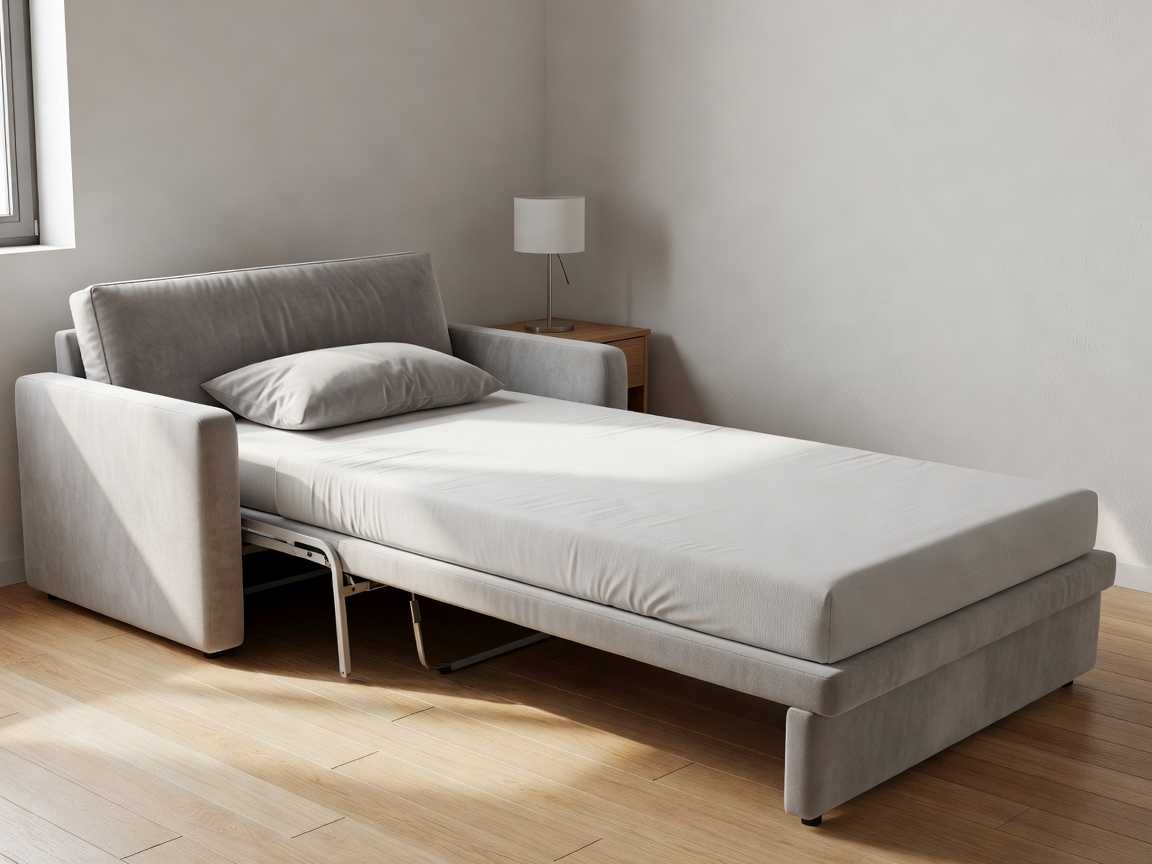
01 / Two modes, one footprint
Test the bed before falling for the sofa.
A folded silhouette can conceal a large open footprint. Measure the entire bed when extended, then include the space needed to walk around it, reach a bedside surface and access the room's door. A plan that technically fits but blocks the route may make hosting more stressful than helpful. Mark the opened dimensions on the floor and rehearse the route around it.
Consider who will sleep there and how often. A guest staying for one night may have different needs from a regular sleeper. Look at the support surface, width, length and whether the bed has an even sleeping area. Where possible, test both the sitting position and the opened bed. Comfort is personal; a mechanism cannot compensate for a surface that does not suit its intended use.
Understand the conversion sequence.
Ask what needs to be removed before opening the bed. Does the seat require cushions to be stored elsewhere? Is there a heavy section to lift, a latch to release or a wall clearance to maintain? The more often the function is used, the more important a simple sequence becomes. Make room for bedding storage nearby so the transition does not require a search through unrelated cupboards.
| What to assess | Why it matters | Room test |
|---|---|---|
| Open footprint | Determines whether circulation remains possible | Mark the full sleeping area and walk around it |
| Seat depth and support | Everyday comfort matters more than occasional novelty | Sit in the usual positions and check support |
| Changeover steps | Complex setup can make the second mode inconvenient | Operate the mechanism and note every separate task |
Keep the room ready for both uses.
Plan where loose cushions, bedding and the coffee table go. If those objects have no designated place, the bed mode may take over the room even when it is not in use. A nearby storage bench can hold blankets and serve as a perch, while a light side table can move aside more readily than a heavy central table. Make sure storage access is not trapped behind the open bed.
Shared homes benefit from a clear agreement about resets: who folds bedding, where it is put away and when the living area returns to its daytime arrangement. This is a small operational detail, but it determines whether the convertible piece feels useful or burdensome.
A guest-ready checklist
- Measure the opened bed and preserve a clear route.
- Check comfort in both sitting and sleeping modes.
- Choose a nearby home for bedding and displaced cushions.
- Practice the changeover before guests arrive.
The goal is not to make a living room pretend to be a bedroom. It is to make its occasional second role possible without sacrificing the room's everyday use.
Consider storage that serves another role · See layout checks